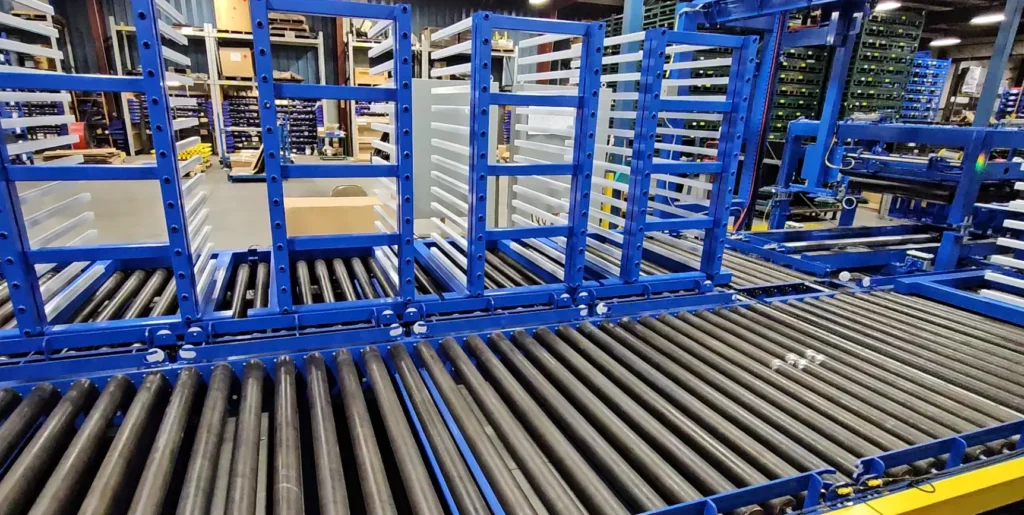
In high-volume manufacturing environments, industrial automation plays a critical role in improving consistency, safety, and throughput. Plymouth Industries designs and builds custom industrial automation solutions that replace manual processes with fully integrated, automated workflows engineered around real-world production demands.
This custom automation system was developed to streamline material handling, pressing, curing, storage, and unloading while maintaining tight process control and operator safety. By combining engineered equipment with intelligent controls, industrial automation systems help manufacturers increase efficiency without sacrificing reliability.
Built for Demanding Manufacturing Environments
This project was engineered for a transportation-focused manufacturer producing large, heavy assemblies that require precise, repeatable handling. Plymouth Industries’ team worked closely with customer engineering and operations to design custom automated machinery that fit existing floor space, supported production targets, and aligned with safety requirements.
The result is an automated manufacturing system that supports continuous production with minimal manual intervention. Through thoughtful design and integration, industrial automation solutions like this enable manufacturers to scale output while maintaining consistent quality.
Key Features of the Automation System
This industrial automation system integrates multiple technologies into a single, cohesive solution:
- Servo-driven automation for accurate product positioning
- Pick-and-place automation systems for repeatable handling
- Pneumatic automation systems for controlled force and motion
- Industrial conveyor automation for smooth material transfer
- Work-in-process automation with programmable dwell times
- Engineered storage and rack systems for organized flow
- Automated return systems to maintain continuous production
Every motion is monitored by sensors that verify position, pressure, and alignment. This level of custom automation reduces scrap, minimizes rework, and improves overall process stability.
Safety-Focused Industrial Automation Design
Safety is a foundational element of effective industrial automation. This system incorporates:
- Perimeter guarding with safety interlocks
- Integrated safety mats at load and unload areas
- Intuitive HMI controls and operator interfaces
- Automated material handling to reduce manual lifting
By automating high-risk tasks, industrial automation equipment helps create safer manufacturing environments while supporting higher throughput and consistent cycle times.
Engineered, Built, and Tested by an Automation Machine Builder
This custom automated machinery was designed, fabricated, programmed, and tested in Wisconsin by an experienced automation machine builder. From structural fabrication and pneumatic integration to controls programming and commissioning, every stage reflects a hands-on approach to custom machine building.
Each system is built for long-term reliability, serviceability, and adaptability, key advantages of working with a trusted industrial machine builder and automation system integrator.
Why Manufacturers Invest in Custom Automation
Manufacturers across transportation, industrial, and heavy-equipment markets rely on custom industrial automation to achieve measurable results:
- Reduced manual handling and labor dependency
- Improved product consistency and process control
- Higher throughput with predictable cycle times
- Enhanced workplace safety
- Scalable automation solutions for manufacturing growth
With the right industrial automation partner, manufacturers gain systems designed specifically for their processes, not off-the-shelf compromises.
Ready to Invest in Industrial Automation?
If you’re evaluating industrial automation systems, planning a new production line, or searching for a custom automation machine builder, Plymouth Industries can help.
Contact Plymouth Industries today to discuss your application and explore turnkey industrial automation solutions designed around your manufacturing challenges.