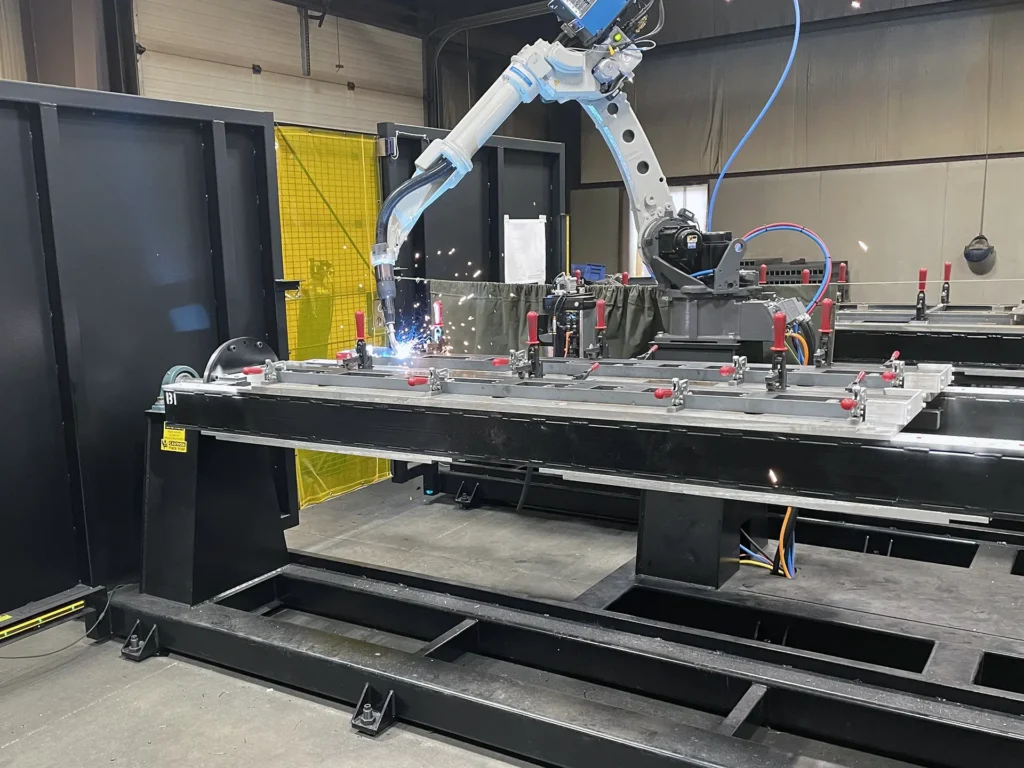
Robotic welding has become a cornerstone of modern manufacturing, delivering the precision, repeatability, and efficiency required for today’s demanding production environments. For manufacturers producing high-volume metal components, robotic welding systems provide consistent weld quality while significantly improving throughput and cost control.
At Plymouth Industries, robotic welding is integrated into a broader suite of production welding services, allowing customers to move seamlessly from design and fabrication to scalable production. By combining advanced robotics with experienced welding professionals, manufacturers can achieve faster cycle times, improved weld integrity, and reliable production capacity for complex metal assemblies.
Investing in Robotic Welding
Industries such as automotive, heavy equipment, construction, and industrial machinery manufacturers are turning to robotic welding automation to remain competitive. Automation allows manufacturers to maintain tight tolerances and consistent weld performance while keeping labor costs predictable.
Key drivers for robotic welding adoption include:
1. Precision and Repeatability
Robotic welding systems operate with programmed paths and parameters, ensuring each weld is performed exactly the same way every time. This level of repeatability is essential for OEM production welding, where quality consistency directly affects product performance.
2. Increased Production Capacity
Automated welding cells operate efficiently for extended production cycles, increasing throughput without sacrificing quality. Manufacturers benefit from faster cycle times and the ability to meet large-volume production demands.
3. Improved Weld Quality
By controlling variables such as arc length, travel speed, and heat input, robotic welding systems produce clean, consistent weld beads with reduced defects.
4. Cost Efficiency Over Time
While robotic welding systems require upfront investment, they reduce long-term production costs through improved productivity, lower scrap rates, and minimized rework.
Robotic Welding Capabilities at Plymouth Industries
Plymouth Industries provides production welding services designed for OEM manufacturing, integrating robotic welding with precision metal fabrication and assembly.
Plymouth Industries supports customers with scalable welding capabilities that include:
- Robotic MIG welding
- High-volume production welding
- Welded steel and aluminum assemblies
- Structural weldments and fabricated frames
- Weld fixture design and production tooling
These capabilities allow manufacturers to transition smoothly from prototype fabrication to full production welding.
Robotic welding systems at Plymouth Industries are engineered to deliver consistent weld performance across large production runs while maintaining strict quality standards.
Supporting High-Volume Manufacturing
Robotic welding plays a critical role in high-volume metal fabrication, particularly when integrated with upstream manufacturing processes such as laser cutting, CNC machining, and precision forming.
When robotic welding is combined with automated fabrication workflows, manufacturers benefit from:
- Streamlined production processes
- Reduced lead times
- Improved supply chain reliability
- Consistent part quality across production batches
For OEM manufacturers, this level of integration ensures that components move efficiently from fabrication through welding and final assembly.
Robotic Welding and Manufacturing Automation
Automation is transforming manufacturing operations worldwide, and robotic welding is often the first step in broader industrial automation initiatives.
Robotic welding cells can integrate with:
- Automated material handling systems
- CNC fabrication equipment
- Quality inspection systems
- Production monitoring software
These integrations enable data-driven manufacturing, allowing companies to optimize production efficiency and maintain strict quality control.
Plymouth Industries continues to expand its robotics capabilities as part of a long-term commitment to advanced manufacturing technologies and production scalability.
Industries That Benefit from Robotic Welding
Robotic welding is widely used across many manufacturing sectors that require durable welded assemblies and high production volumes.
Common industries include:
- Automotive and transportation equipment
- Construction and heavy equipment manufacturing
- Industrial machinery and equipment
- Material handling systems
- Agricultural equipment manufacturing
These industries depend on reliable welded structures that must meet strict performance and durability requirements.
Partner with Plymouth Industries for Robotic Welding
Manufacturers seeking reliable robotic welding services and production welding capabilities benefit from working with a fabrication partner that understands both automation and metal fabrication.
Plymouth Industries combines robotic welding technology with decades of experience in custom metal fabrication, production welding, and engineered manufacturing solutions. The result is a streamlined production process that delivers consistent quality and dependable lead times.
Ready to improve your welding efficiency and production capacity? Contact Plymouth Industries today to discuss your next project and learn how robotic welding can support your manufacturing goals.